
Alexander Meller
ALEXANDER MELLER (American, 1920-2002)

Alex Meller sitting among his sculpture, ca 1950
Alexander Meller was a Surrealist painter and sculptor associated with the postwar Los Angeles modernist scene. His work has often been compared to Roberto Matta, while influences ranging from Wilfredo Lam to Cubism and biomorphic abstraction can also be seen throughout his paintings and welded metal sculpture. Combining elements of surrealism, industrial design, architecture, and psychological fantasy, Meller created a deeply personal visual language that could appear at once exuberant, humorous, futuristic, and unsettling.
Born Hanany Srule Chaimov Meller on January 6, 1920 in Harbin, Manchuria, China, Meller was part of the Jewish émigré community that developed there during the early twentieth century. His father, Saul Meller, was originally from Russia, while his mother, Aidia (Anna) Seksfinger Meller, was born in Warsaw, Poland. In 1937, the family emigrated to the United States, arriving in California and initially settling in Beverly Hills among extended family already established in Los Angeles.
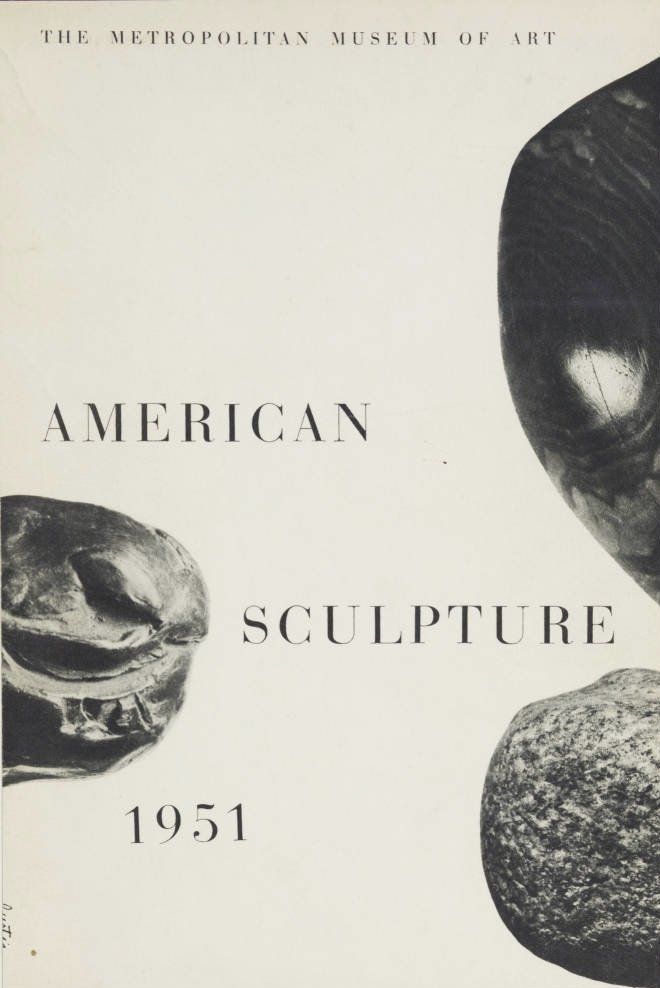
The Metropolitan Museum of Art, “American Sculpture 1951”, Exhibition Catalog
By the time Meller enlisted in the United States Army in October of 1941, he was already identifying his occupation as “artist.” Though not yet a U.S. citizen at the time of enlistment, he volunteered for military service and was honorably discharged in 1945. Themes of wartime anxiety, machinery, movement, and psychological tension would later surface repeatedly throughout his paintings and sculpture in works with titles such as The Dogface, Fighting Cock, Tomcat, and Pilot Meets His Midnight.
Meller’s emergence within the Southern California art world appears to have begun earlier than previously documented. In 1950, he participated in the Los Angeles County Museum’s “Annual Exhibition: Artists of Los Angeles and Vicinity,” exhibiting a work titled The Dogface. Around this same period, Meller became connected to a remarkable creative circle surrounding Edith Cox Eaton and the historic Juana Briones de Miranda ranch property in Los Altos, California. The property had evolved into something of an informal arts colony, frequented by artists including Marjorie Eaton, Lucretia Van Horn, and Louise Nevelson. Meller listed Eaton’s address as his residence when he volunteered for military service in 1941, suggesting he spent meaningful time within this environment during his formative years.
Recognition followed quickly. In 1951, Meller was one of 101 artists selected for the Metropolitan Museum of Art’s exhibition American Sculpture 1951. Other exhibitors included Alexander Calder, Alexander Archipenko, Leo Amino, Bernard Rosenthal, and Viktor Schreckengost, among many others. Meller’s contribution, a welded steel sculpture titled The Tango, was exhibited with a listed sale price of $1,500 — a considerable sum for a young artist at the time.
The following year, Meller exhibited The Tango in Art Today, sponsored by the Los Angeles Art Association. Writing in Art News, critic Jules Langsner praised the emergence of Meller’s “virile and handsome construction” assembled from welded gears and industrial forms. Shortly afterward, his sculpture Tomcat was included in the Los Angeles County Museum’s 1952 Annual Exhibition: Artists of Los Angeles and Vicinity, where Los Angeles Times critic Arthur Millier singled the work out as “witty” amid what he otherwise described as a largely uninspired exhibition.
Meller’s most significant solo exhibition came in July of 1952 with a one-man show at the influential Felix Landau Gallery on La Cienega Boulevard in Los Angeles. The exhibition included both paintings and welded metal sculpture and placed Meller among an important generation of emerging postwar artists exhibiting in what would soon become Los Angeles’ celebrated “Gallery Row.”
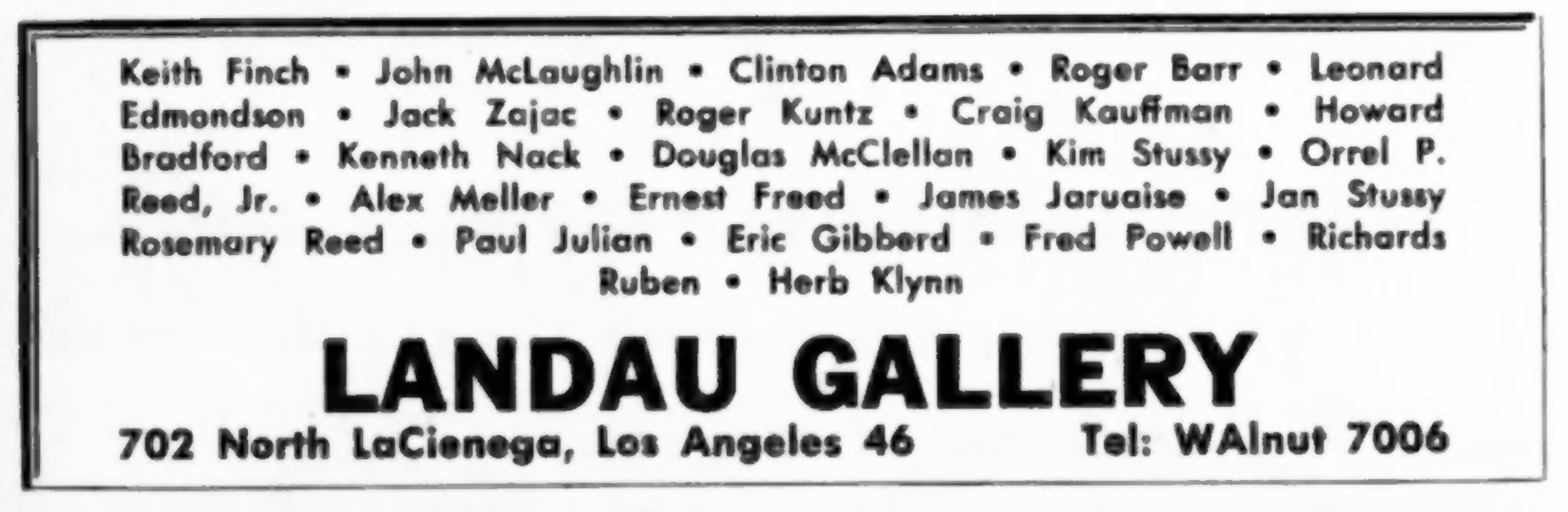
Felix Landau Gallery Advertisement
Reviewing the exhibition in Art News, Jules Langsner described Meller as “an artist with immense vitality,” praising works that displayed “luminously transparent forms and activated deep space, close to Matta in spirit.” Other paintings, Langsner noted, moved toward “lurid fantasy” and psychological instability, producing an oscillation “between infectious exuberance and the depressing realization that something has gone askew.” The tension between playful invention and psychological unease remains one of the defining characteristics of Meller’s work.
Writing in Arts Magazine, critic Barbara Barstow Cobb commented on the artist’s “marvelous facility with prismatic effects” and his unusual combination of industrial precision, architectural drafting, and surrealist fantasy. She noted the “gyrating figures” and hidden imagery embedded throughout the paintings, while observing that, despite their visual density, the compositions retained a surprising harmony and coherence.
Ironically, the exhibition immediately following Meller’s at the Landau Gallery featured minimalist painter John McLaughlin — a dramatic counterpoint to Meller’s theatrical and psychologically charged imagery. As Langsner remarked at the time, “Landau seems to be running the gamut this summer, jumping from the impetuosity of Meller to the austerity of John McLaughlin.”

Alexander Meller, The Tango, Metal Sculpture, Height 28 1/2’
Although Meller never achieved the lasting institutional recognition of some of his contemporaries, he continued participating in Southern California exhibitions throughout the 1950s. His welded sculpture Dancing Figure received favorable critical mention during the 1956 Chaffey Invitational Exhibition in Ontario, California, where he exhibited alongside artists including Helen Lundeberg, Lorser Feitelson, John McLaughlin, Richard Diebenkorn, and Millard Sheets.
During this period, Meller married Hungarian-born pianist Erica Zador, with whom he had a son, Robert Michael Meller. By the late 1950s, his public exhibition activity appears to have gradually diminished. He later married Lila Ofstein in 1958, and over subsequent decades lived in Banning and later Whitewater, California. Records suggest that real estate investment became his principal occupation for much of his later life, though he continued producing artwork privately. Meller also maintained an ongoing interest in music, co-authoring and registering copyrighted musical compositions during the 1970s and 1980s.
Late in life, Meller increasingly adopted the name Alexander Adam Dare, formally completing the legal name change in 2002 after years of correspondence and filings. The transition appears to reflect a lifelong pattern of reinvention and evolving personal identity that paralleled the unusual trajectory of his artistic career.
Alexander Meller died on November 1, 2002, shortly after the legal completion of his name change. He is buried alongside his wife Lila at Forest Lawn Memorial Park in Cathedral City, California.
Today, Meller’s work survives as a striking and largely overlooked contribution to postwar California modernism — combining surrealism, abstraction, industrial design, humor, psychological tension, and wartime memory into a singular and deeply imaginative body of work.
Exhibitions:
The Metropolitan Museum of Art, New York; “American Sculpture 1951”, December 7, 1951-February 24, 1952
Los Angeles Art Association, Los Angeles, California; “Art Today”, May, 1952
Los Angeles County Museum, Los Angeles, California; “1952 Annual Exhibition: Artists of Los Angeles and Vicinity”, June 28-August 10, 1952
Felix Landau Gallery, Los Angeles, California; One-Man Exhibition, July 7-26, 1952
Chaffey Community Art Association (Chaffey Community Museum of Art), Ontario, California, “13th Annual Contemporary Painting Exhibit”, October 24-November 1, 1953
Chaffey Community Art Association (Chaffey Community Museum of Art), Ontario, California, “16th Annual Invitational Exhibit”, October 21-28, 1956
Press And Research Sources:
Los Angeles County Museum; “1950 Annual Exhibition: Artists of Los Angeles and Vicinity”, Exhibition Catalog, 1950
The Los Angeles Times; “Sculptors Get Bid to Exhibit”, November 18, 1951
Art News; “Art news from Los Angeles”, by Jules Langsner, May, 1952: vol. 51, issue 3, page 49
Art News; “This Summer in Los Angeles”, by Jules Langsner, June-August, 1952: vol. 51, issue 4, page 89
The Los Angeles Times; “Art: Creativity Lacking in Museum Exhibition”, by Arthur Miller, July 6, 1952
The Los Angeles Times; “Art: Art Events This Week”, July 13, 1952
The Arts Magazine, Los Angeles; “One-Man Show at the Landau Gallery”, by Barbara Barstow Cobb, August, 1952
ART D’Aujourd’hui (Art of Today), Paris; “La Sculpture Abstraite Aux U.S.A. (Abstract Sculpture in the U.S.A.)”, by George L. K. Morris , January, 1953
The Pomona Progress Bulletin, Pomona, California; “Gallery Talks Slated at Chaffey Art Show”, October 24, 1953
The San Bernardino County Sun, San Bernardino, California; “Sculpture Exhibit Will Be in Charge of Noted Pamona Artist”, October 19, 1956
The Los Angeles Times; “In Ontario”, October 28, 1956
Genealogical and archival research compiled by Sharon L. Schooler Snider, including immigration, military enlistment, marriage, and family records relating to Alexander Meller (Hanany Srule Chaimov Meller / Alexander Adam Dare)
Additional archival material and exhibition documentation courtesy of Jean-Luc Bourdon and Barry Landau